-
 Media gallery
-
 Media gallery


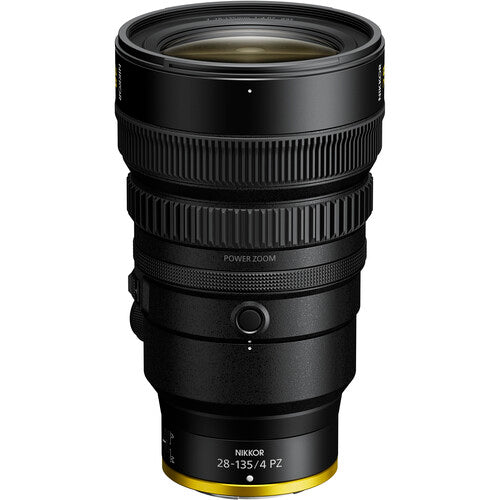
Nikon Z 28-135mm F/4 PZ Lens
- Sale price
- £1,446.00
- Regular price
-
- Regular price
- £1,446.00
- Unit price
- per
Est. Shipping : Within 2 Business days
Est. Delivery : Within 5-7 Business days
Couldn't load pickup availability
Product Description
Product Description
Nikon Z 28-135mm f/4 PZ Lens Overview
Power Zoom for Cinematic Precision
The Nikon Z 28-135mm f/4 PZ is a full-frame standard zoom lens designed for hybrid creators and videographers. Featuring a motorized power zoom mechanism with 11 selectable speeds, it enables smooth, organic transitions ideal for professional video production.
Flexible View Span & Fine Glasswork
Stretching from 28mm to 135mm, this lens offers nimbleness from broad sceneries to far-off frames. Its inner build holds 18 glass bits in 13 clusters, with 3 ED, 1 aspherical ED, and 4 aspherical forms, wrapped in Nikon’s clever Meso Amorphous and fluorine layers to tame flare and stray glow.
Swift Focus & Gentle Breathing
Driven by a stepping gear (STM), the lens grants hushed, swift focus moves. It's tuned to hush focus breathing—keeping your frame steady during pull-focus, a must for smooth storytelling on film.
Rig-Ready & Far-Off Friendly
With zoom tucked inside, balance stays true on gimbals and frames. It welcomes remote zoom taming through NX Tether, SnapBridge, or NX Field, and offers handy L-Fn buttons you can shape to your liking.
Close Focus & Macro Capability
With a minimum focus distance, the lens allows for dynamic close-ups and semi-macro shots across the zoom range.
Design & Accessories
Weighing approximately 1,120g (without tripod collar), the lens includes a rectangular filter adjustment window, a 95mm front filter thread. It’s built with dust- and drip-resistance for reliable field use.
Ideal For
Perfect for filmmakers, documentarians, and solo creators seeking a single lens solution for 8K video, dynamic zooming, and professional-grade control. It’s a game-changer for Nikon Z-mount video workflows.
Nikon NIKKOR Z 28-135mm f/4 PZ Specs
| Focal Length |
| Maximum Aperture | |
| Minimum Aperture | |
| Lens Mount | |
| Interchangeable Mount | |
| Lens Format Coverage | |
| Image Circle | |
| Angle of View | |
| Optical Design | |
| Filter Thread | |
| Zoom Ratio | |
| Minimum Focus Distance | |
| Magnification | |
| Aperture/Iris Blades | |
| Image Stabilization | |
| Lens Mounting | |
| Gear Standard | |
| Gear Rotation | |
| Electronic Communication | |
| Diameter | |
| Length | |
| Weight |

Notified by email when this product becomes available

£1,446.00

Why Choose Us?
Choose Cameriz Limited, your trusted online destination for brand new, top quality camera gear at unbeatable value.
You May Also Like
FREQUENTLY ASKED QUESTIONS
You've Got Any Questions?
At Cameriz Limited, we offer 2 years warranty on Camera, Camera Lens and Camcorders. 6 months warranty on Camera Flash and No warranty on Accessories like, Battery.
We offer a hassle-free return policy. If you're not satisfied with your purchase, you can return it within 14 days for a refund. Product must be in original sealed pack condition to qualify for refund.
Delivery times vary based on your location, but we typically ship within 1-2 business days from the date of order. You'll receive tracking information as soon as your order is dispatched.
